

The Sharks should draft a defenseman at second overall. Here’s why.
Ivar Stenberg may be a star in the making, but elite NHL defenders are hockey's rarest resource.

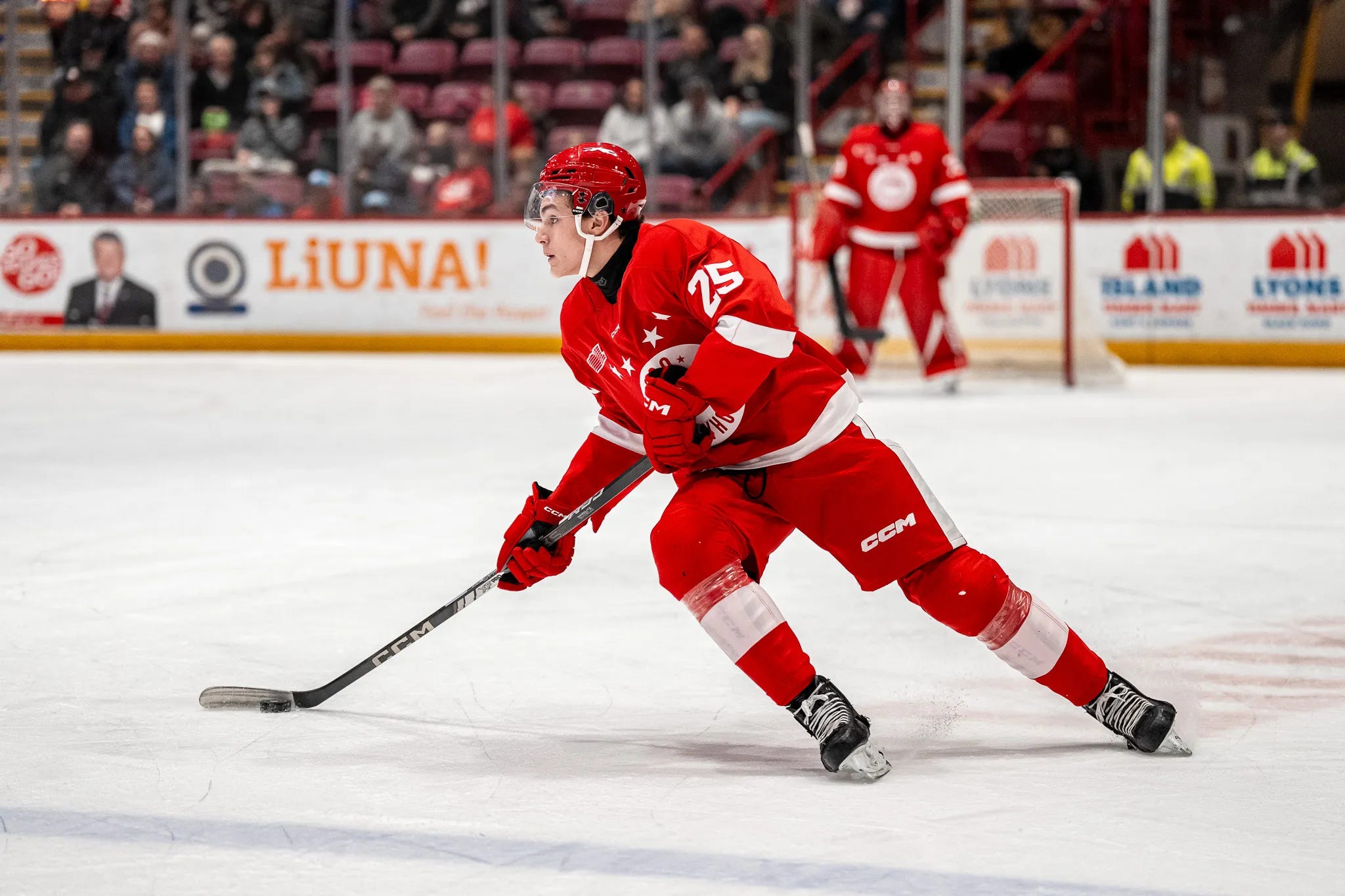
If you’re a Sharks fan, there’s roughly a 50% chance that the headline of this article alone has your blood pressure on the rise. So let’s start with a collective reality check.
Ivar Stenberg is a winger who played his entire 2025-26 season in a men’s pro league, skating on an international ice surface.
Chase Reid is a defenseman, four months younger, and spent last season competing against his own peer group in the OHL, on a smaller North American sheet.
Even if they’d played in the same league last season, under the exact same conditions, their positional difference would make a true apples-to-apples comparison impossible. Their disparate development paths to date add another layer of complexity to that evaluation, one which will divide the most experienced scouts in the game when late June rolls around.
Personally, I’ve watched plenty of tape on both players. Both are impressive. I couldn’t for the life of me tell you which is “better.” I certainly can’t claim to know which will be the more impactful NHLer.
Not even the professionals can reach consensus, and their expertise runs far deeper than my own. Like any fan or analyst, I’m left to interpret and weigh the opinions of those experts. Some feel the gap between Stenberg and Reid (or any of the top defensemen in the draft class) is significant. Others say it’s negligible. Some even posit that Reid is the better player.
That lack of clarity at the top supports a middle ground. A gap may exist, but it is probably not a chasm. When the gap is undeniable, scouts are on the same page. When it’s not, they aren’t.
If the Sharks disagree, and feel the gap between Stenberg and the rest of the field is significant, they should draft Stenberg. But if they believe the gap is minimal, the path forward for Mike Grier and his staff is clear: address the organization’s most glaring need and draft a defenseman.
Why?
Most drafts do not yield an elite player at every position. That is why the “best player available” argument is so strong — choosing the best available defender over the best available forward, for example, could mean missing out on elite talent all together.
We’ve seen this script play out a few times over the past 20 years. Erik Johnson taken over Jonathan Toews. Olli Juolevi over Matthew Tkachuk. David Reinbacher over Matvei Michkov. But historically speaking, egregious, franchise-altering mistakes made by prioritizing positional fit over generational upside are fairly rare in the modern era.
Far more often, we’ve actually seen scouts “reach” over the draft’s best defenseman or forward to draft a different defenseman or forward. Those decisions can still work out just fine — Dallas drafted Miro Heiskanen third overall in 2017, just before Colorado took Cale Makar fourth. Both teams landed franchise defensemen that day, even if Makar became the more dynamic player.
Today, there’s no way for us to know whether or not Ivar Stenberg will develop into an elite, top line winger, or if Chase Reid will become a true number one defenseman. What we do know is this: In a vacuum, an elite defender is much more valuable than an elite winger. And by far the best way to acquire an elite defender is through the NHL entry draft.
Draft an elite defenseman, or risk going without.
I created a composite list of the league’s top defenders by points and ice time, 27 total players capable of handling first-pairing roles on competitive teams. These players are separated out into four tiers — 1) generational talents, 2) elite number one defenders, 3) number one defenders and 4) top-pairing players. These rankings are based on current contribution, not peak abilities.
Tier 1: Cale Makar, Quinn Hughes, Zach Werenski, Rasmus Dahlin.
Tier 2: Charlie McAvoy, Miro Heiskanen, Mo Seider, Matthew Schaefer, Jake Sanderson.
Tier 3: Evan Bouchard, Lane Hutson, Thomas Harley, Jackson LaCombe, Noah Hanifin, Roman Josi, Adam Fox, Josh Morrissey, Erik Karlsson, Travis Sanheim, Jacob Chychrun.
Tier 4: Aaron Ekblad, Bowen Byram, Filip Hronek, Mikael Sergachev, Ivan Provorov, John Carlson.
The top two tiers include a total of nine players. Three were top-three picks, five were top-five picks and eight were selected in the top ten. In fact, just one of the nine was selected later than 8th overall — Charlie McAvoy at 14th. In other words, every single player in the top two tiers was drafted in the first half of the first round.
Of the 27 total players on this list, eight were top-five picks, 15 were top 10 picks and 21 (more than 75%) were first-round picks. Just six were selected outside the first round, and no player on this list was drafted later than the early third round. Only one of the 27 players was drafted outside of the top two rounds (Adam Fox, 66th overall).
These players don’t tend to move much, either. Only seven players on the list above have been traded mid-career — a group that includes just one of the top nine. Only four of the 27 have played for more than two teams. Just one has made it to unrestricted free agency.
Value is an objective measure, even if upside is not.
The defensemen on this list all contribute 22-24 minutes a night, on average. Only nine wingers in the entire NHL averaged over 20 minutes per night. That group reads like a who’s who of future Hall of Famers: David Pastrnak. Nikita Kucherov. Mikko Rantanen. Kirill Kaprizov. Jason Robertson. Matt Boldy. Artemi Panarin. Eight of the nine scored at a 1.08 points-per-game clip or better last season. That level of contribution is a lot to expect from Stenberg. He’d have to become one of the top ten wingers in the game to even approach the value of a high-end, top-pairing defender.
Of the eight wingers who averaged over 20 minutes a night and over a point-per-game last season, just half were first-round draft picks and only one was a top-10 pick (Rantanen, 10th overall). Two were drafted in the second round (Kucherov, Robertson), one in the fifth (Kaprizov) and one went un-drafted entirely (Panarin). The proof is in the data. It is much, much easier to find an elite winger outside of the first round than it is to find an elite defenseman.
No risk, no reward.
All drafts and draft picks carry a degree of risk. Ultimately, scouting reports are just projections. They do not dictate reality, nor do they predict the future with any meaningful degree of certainty. The Sharks have done an excellent job at turning their most valuable draft capital into forwards that look like home-run picks — Macklin Celebrini, Will Smith, Michael Misa, Igor Chernyshov, William Eklund. Frankly, they have banked enough success to absorb a failure.
Now, San Jose has the freedom to bet on an area of true need. It’s a gift, and one they’re unlikely to receive again anytime soon. The time to address San Jose’s long-term outlook on the blue line is now.
Joseph, nice piece. Could not agree more with the need to draft a defenseman.